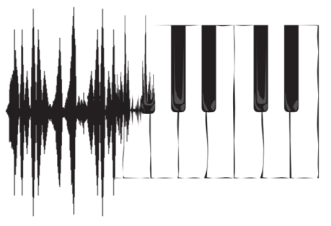

Three of four planned articles in a series that explores the acoustical foundations of key developments in western music over the centuries. Since they first appeared several years ago, these articles have proved valuable sources for students, academics and for those with basic musical knowledge who are curious about why music has developed the way it has.
In the first article – possibly the most widely-read item on the site – we discuss the role of the harmonic series in the perception of timbre before exploring how it has influenced the evolution of melody & harmony, as well as rhythm and tempo, since the Middle Ages. The fourth and final article Synthesis, which is in preparation, will propose ways in which the principles discussed in the first three can continue to inform musical creation now and in the future.
Read the articles here;
Pythagoras and the Music of the Future Part I – Timbre
Pythagoras and the Music of the Future Part II – Melody & Harmony
Pythagoras and the Music of the Future Part III – Musical Time
Pythagoras and the Music of the Future Part III – Musical Time (contd.)
 Actually, I prefer ‘practice makes permanent‘!
 (in other words, ‘elitist’) and that teaching with an emphasis on music notation is a dominant symptom of the overly academic approach to musical pedagogy. This, she claims, renders the subject inaccessible and irrelevant to the needs of many if not the majority of school age students. As she puts it, ”music has always been taught in a far too academic way, meaning that theoretical knowledge is the main route to advancement”. In response, there has been an outcry of indignation in the form of a
  A few years ago, I came across an interesting and thought-provoking article by
  Pythagoras and the Music of the Future is a series of articles in which I discuss, in accessible terms, I hope, the central influence that the harmonic series has had on the development of western music since the Middle Ages. I look closely at the connection between the harmonic series and the conventions of the musical structures of timbre, melody and harmony and musical time i.e. rhythm meter and tempo.
 It seems that the recent post and article in defense of group teaching has struck a chord with quite a few readers. However, whilst they did their job in defending the practice of group teaching they didn’t offer too many solutions to the challenges that teachers, especially those new to the situation, can face.
  Robert Lennon Musician & Educator