Pythagoras and the Music of the Future Part II

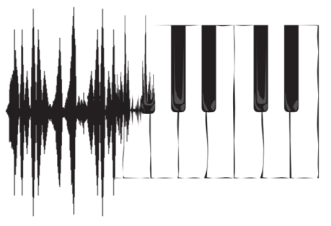
It’s Harmonic Wave 2a relief finally to be able to post the next article in my series about the relationship between musical structures and the harmonic series. It’s a relief because my crowded schedule, which included writing a new (now finished) piece for solo piano, meant that I could only work on it sporadically. However, it’s done now!

Whereas the first article dealt with timbre, this one focuses on melody on harmony (well, mostly harmony actually) and, after tracing the development of harmony in relation to the proportions inherent in the harmonic series, illustrates the premise that music based on functional harmony (tonal music) and atonal music are very similar in at least one very important regard.

The two are often thought of as very different and even in opposition to one another, but in fact one grew out of the other and both are founded on proportions to be found at points – distant points perhaps – but nonetheless, points on the continuum which is the harmonic series.

It’s all becoming reminiscent of Heraclitus and the ‘unity of opposites’ once more I think! Read more here.

Pythagoras and the Music of the Future

Harmonic Wave 2I am just about ready to introduce the first in a projected series of articles discussing, in accessible terms I hope, the influence that the harmonic series has had on musical development since the Middle Ages. I will be discussing not only the connection between the harmonic series and timbre (the obvious one), but also the connections between this and the conventions governing musical structures such as rhythm, melody and harmony.

Ultimately, I will arrive at the conclusion that there needs to be a clear, natural (as opposed to contrived), relationship between the the diverse sets of proportions inherent in the harmonic series, and musical expression – now and in the future. Ironically, or so it might seem, I will also argue that whereas the development of functional harmony and therefore tonality was strongly influenced by our perception (maybe subliminal – I don’t know) of  the ‘inner workings’ of musical sound, the music that has already left, and will leave, tonality where it belongs – in the past – is equally bound up with these inner workings – particularly as represented by the harmonic series.

Many will know a great deal about the relationship between the harmonic series and timbre already, so may not find anything particularly new in the first article which sets the scene, so to speak.  To find out if you’re one of them, click here.

Welcome

This is my way of sharing ideas about contemporary music (which for this purpose, means ‘classical’ music of the 20th & 21st centuries) and about preparing the next generation of musicians.

When talking about the next generation I mean ‘musicians’ very much with a ‘small m’, because one of the things I feel very strongly about is that for too long, music education has been based on the conservatory model, with teachers often dismissing students as lacking in promise, talent, potential or whatever, in a system that often insists on ‘ear tests’ before admitting students to lessons at all!  This means that the innumerable benefits of musical activity are denied those who do not fit the conservatory model. More later.

Likewise, I want to share ideas about where contemporary musical thinking is going. I know where mine is going, and it’s in the opposite direction to those who want to go back to tonal structures and write in styles called ‘neo’ this, that or the other!  Issues such as this, and others, will be explored in time.

I look forward to some interesting discussion as a result of my posts over a period … possibly an extended period, because, in view of all the things I have to do, I think this blog might take some time to develop!

Robert Lennon